

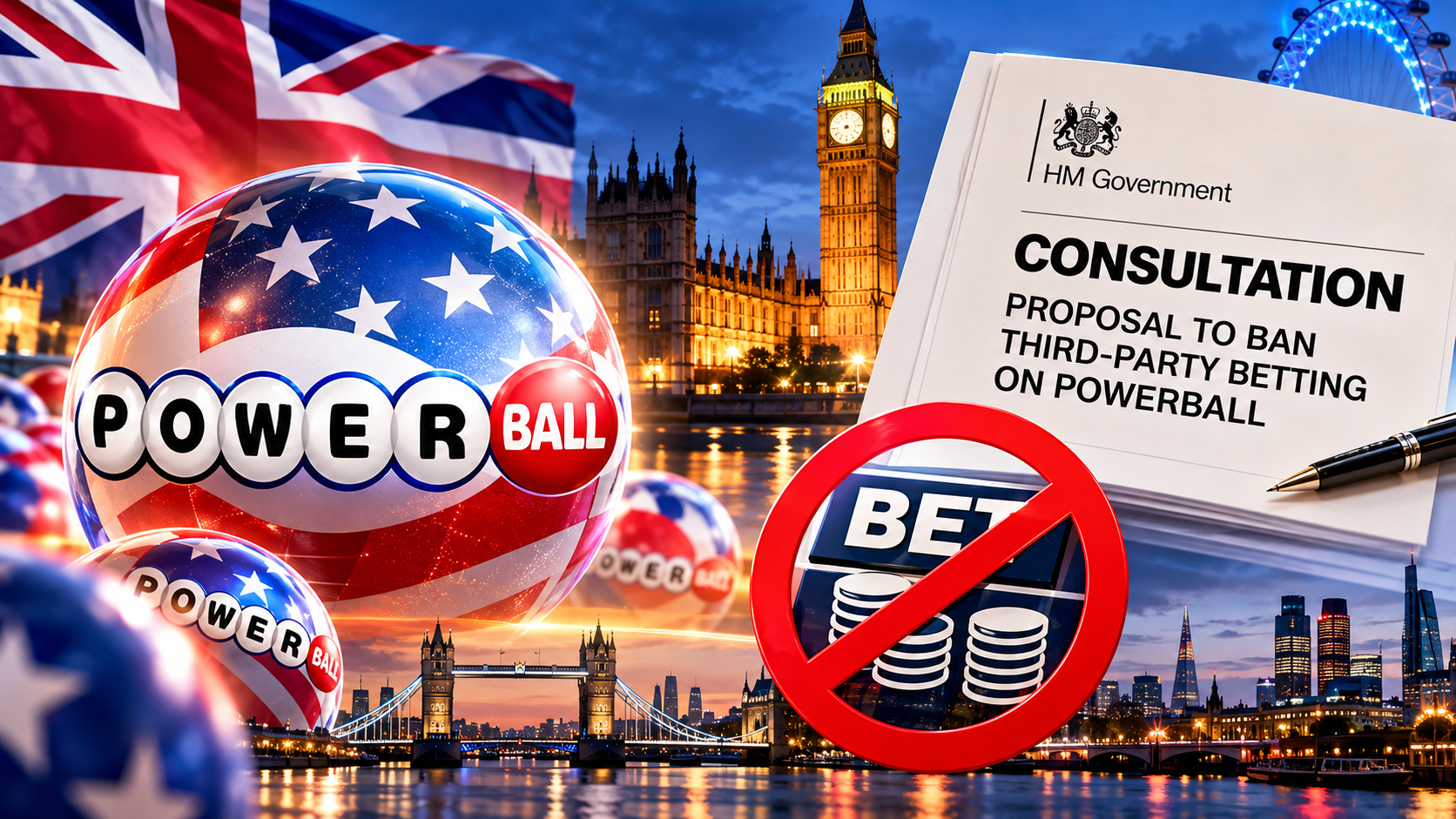
UK Government Moves Toward Ban on Third-Party Powerball Betting as National Lottery Protects New £1bn Opportunity

The arrival of Powerball in Britain has created an unusual situation in which UK consumers can either play the official National Lottery version of the famous American draw game or place a commercial bet on the outcome of the same underlying US draw. Now the Government is considering closing that gap, launching a six-week consultation on whether licensed betting operators should be prohibited from offering third-party Powerball bets to customers in Great Britain.
Powerball’s arrival in the United Kingdom was one of the biggest changes to the British lottery market in decades. For the first time since the game was created in the United States in 1992, players outside America were brought directly into the Powerball jackpot system through a national lottery. Tickets for the UK version went on sale through The National Lottery on 21 July 2026, following regulatory approval from the Gambling Commission.
Barely two months later, however, Powerball has become the subject of a new regulatory debate.
The Department for Digital, Culture, Media and Sport has opened a consultation on prohibiting licensed gambling businesses from offering customers in Great Britain bets on Powerball results. The consultation was published on 23 September 2026, will remain open for six weeks and closes at 23:59 on Wednesday 4 November 2026. Individuals, betting companies, lottery operators and other interested organisations are all being invited to submit evidence and views.
The proposal is important because it goes beyond a technical change to gambling licences. It raises a fundamental question about what Powerball has now become in Britain.
Before July, Powerball was essentially a foreign lottery from the perspective of a UK player. A British consumer could not buy an official UK National Lottery Powerball entry, but certain gambling companies could allow that customer to bet on what numbers would be drawn in America.
Since July, that distinction has changed completely.
Powerball is now itself a National Lottery product in Britain.
And that has left the Government asking whether betting operators should still be able to sell an alternative product based on exactly the same draw.
Why Is the Government Looking at Powerball Betting?
The legal situation exists because of the unusual structure of the new British Powerball game.
Section 95 of the Gambling Act 2005 prohibits holders of betting licences from accepting bets on the outcome of lotteries that form part of The National Lottery. That principle already applies to familiar games including Lotto, EuroMillions and Thunderball.
Powerball is different because although UK consumers now participate through The National Lottery, the underlying draw still takes place within the US Powerball system. The American lottery draw itself does not technically form part of the British National Lottery.
That distinction has created what is effectively a regulatory gap.
Licensed betting operators can currently take a bet from a British customer on the outcome of a Powerball draw even though another British customer can buy an official National Lottery Powerball entry linked to that same draw. The Government says the existing wording of Section 95 does not automatically capture those third-party bets because the underlying US draw remains outside The National Lottery.
The consultation therefore proposes a new licence condition using powers under Section 78(1) of the Gambling Act 2005. The condition would apply to relevant Gambling Commission licences and prevent operators from offering bets on Powerball results to consumers in Great Britain. The affected licence categories would include general betting, pool betting and betting intermediary licences.
This is important terminology. The Government is not proposing to ban Powerball in Britain.
It is considering banning one specific way of accessing an outcome linked to Powerball: placing a commercial bet with a third-party gambling operator rather than participating through the official National Lottery product.
Playing Powerball and Betting on Powerball Are Not the Same Thing
For players, this is probably the most important distinction in the entire debate.
When somebody buys Powerball through The National Lottery, that customer is participating in the official UK version of the game. The National Lottery is part of the international Powerball jackpot arrangement, with UK ticket sales contributing to the shared jackpot pool.
When somebody uses a third-party betting operator, they are not necessarily purchasing a Powerball lottery entry at all.
They are entering into a betting contract with a gambling company based on the result of the Powerball draw.
The numbers may look familiar. The jackpot being referenced may be the same enormous headline jackpot. The result used to settle the wager may be the official US Powerball result.
But legally and commercially, they are different products.
That distinction has become far more important since official Powerball participation became available in Britain.
The Government says there is a risk that customers may believe they are playing Powerball when they are actually betting on Powerball. It points to previous experience with EuroMillions, arguing that voluntary measures and additional Gambling Commission guidance did not fully eliminate confusion when lottery betting products existed alongside official National Lottery participation.
Whether significant confusion currently exists around Powerball is one of the questions the consultation is trying to answer.
In fact, the Government explicitly acknowledges that the evidence is incomplete.
The Evidence Gap Matters
One of the more interesting aspects of the consultation is what the Government does not claim to know.
It says there is limited up-to-date evidence showing how many people presently using third-party Powerball betting products would switch to purchasing official National Lottery Powerball entries if those betting products disappeared.
That matters enormously.
If virtually every customer currently betting on Powerball moved across to The National Lottery following a prohibition, then the effect on official Powerball sales and good-cause contributions could be meaningful.
If many of those customers simply stopped playing altogether, the result could look very different.
And if consumers already clearly understand the distinction between a lottery entry and a bet on a lottery result, the argument centred on customer confusion would also need to be considered in that context.
The Government is therefore asking consultation respondents for evidence about consumer awareness, behaviour and likely switching patterns rather than presenting those points as established facts.
That makes this consultation more significant than a simple announcement that a ban is definitely happening.
As of 25 September 2026, this remains a proposal under consultation, not a completed prohibition.
Powerball Has Become a Major Part of the National Lottery Strategy
The timing is also important because Powerball is not a minor addition to Allwyn’s National Lottery portfolio.
Allwyn launched the British Powerball product in July as part of a much wider programme of change under the fourth National Lottery licence. The official UK game costs £4 per line and gives British players access to the shared Powerball jackpot while operating its lower prize tiers separately from the US game. UK jackpot winners receive their jackpot through a 30-year payment structure rather than the cash-option system available to American jackpot winners.
Powerball’s expansion to Britain was historic in its own right. It represented the first time a non-US lottery had joined the Powerball jackpot arrangement. With The National Lottery participating, 49 lotteries contribute to the shared jackpot pool.
The game also arrived with extraordinarily large headline numbers.
When UK tickets went on sale on 21 July, Allwyn promoted an estimated £300 million jackpot for the first UK opportunity to participate, describing it as the largest National Lottery jackpot yet offered to British players.
The longer-term financial expectations are potentially even more significant.
Allwyn and the Government say Powerball is expected to generate approximately £1 billion in additional funding for UK good causes over its first five years.
Against that background, the existence of commercially operated alternatives based on the same draw is understandably receiving regulatory attention.
The £1.8 Billion Good-Causes Question
Good-cause funding sits at the centre of the Government’s argument.
The National Lottery currently generates around £1.8 billion per year for causes covering areas including arts, heritage, sport and communities. The Government says approximately 23% of National Lottery product sales goes towards good causes.
A third-party betting company works differently.
If someone spends money betting on Powerball through a bookmaker or other licensed betting operator, that wager is part of the operator’s gambling business. The company is not generally required to allocate the same proportion of that wager to National Lottery good causes.
From the Government’s perspective, the concern is therefore not simply whether a customer wins or loses.
It is where the player’s spending takes place.
If somebody who would otherwise have purchased an official £4 Powerball line instead places an equivalent third-party bet, that spending does not flow through the National Lottery funding model in the same way.
The Government says this could reduce the amount ultimately generated for good causes, particularly because third-party operators can market products around Powerball’s enormous jackpots without having the same obligation to direct proceeds towards National Lottery-funded projects. It also notes that alternative betting products can sometimes be sold at prices below the cost of an official lottery entry.
Again, however, there is an important qualification.
That argument depends partly on customers actually switching from third-party products to The National Lottery if those alternatives are prohibited.
The Government itself says contemporary evidence on that behaviour is limited and is actively requesting information through the consultation.
Why Section 95 Is So Important
Much of the debate comes back to the special position occupied by The National Lottery.
The National Lottery is not simply another licensed online gambling operator competing in the same regulatory category as bookmakers and casinos.
Its legal framework is different.
The current Government consultation describes The National Lottery as occupying a unique position because it was established specifically to combine prize-based participation with funding for projects throughout the UK. Since its creation in 1994, more than £53 billion has been generated for over 680,000 projects, according to figures cited by the Government.
Section 95 of the Gambling Act helps preserve a boundary between National Lottery products and commercial betting products by restricting betting on National Lottery outcomes.
The current Powerball situation is unusual precisely because the international structure of the draw means that the existing legislation does not neatly produce the same result.
From the Government’s perspective, the proposed licence condition would effectively restore that boundary without requiring a more sweeping prohibition on lottery betting generally.
This Would Not Ban Betting on Every Foreign Lottery
That distinction is particularly important for E-Lotto.com readers.
The proposal is specifically targeted at Powerball.
The consultation makes clear that licensed operators would still be able to offer bets on lotteries that are not part of The National Lottery framework. It specifically gives the Irish Lotto as an example of a product on which betting could continue.
The Government considered a much wider prohibition on betting on all lotteries but concluded that approach would have a disproportionate effect on gambling businesses.
It also considered requiring betting companies offering lottery bets to contribute money towards good causes, but regarded that option as disproportionate and potentially liable to blur the distinction between commercial betting and official National Lottery participation even further.
Voluntary action was considered as another alternative. The Government’s position is that this approach had previously proved insufficient in the EuroMillions context, where guidance and voluntary measures were unable to eliminate concerns about consumers distinguishing between a lottery ticket and a bet on a lottery result.
So this should not currently be interpreted as the beginning of a proposed blanket ban on international lottery betting.
The consultation is much narrower.
Powerball has become a special case because it is simultaneously an international US-based draw and an official British National Lottery product.
Powerball Has Effectively Created a New Category in Britain
The bigger story may be that Powerball does not fit comfortably inside the traditional categories British players have been used to.
Lotto is unmistakably a UK National Lottery game.
EuroMillions is a multinational lottery but is deeply established within The National Lottery’s British offering.
Traditional lottery betting companies, meanwhile, have built businesses around allowing customers to wager on the results of international lottery draws without necessarily purchasing entries into those lotteries.
Powerball now occupies territory between those worlds.
The underlying draw remains American and continues to take place within the US Powerball network, yet British ticket holders are official participants in the shared jackpot through The National Lottery.
According to the official Powerball organisation, the jackpot is the component shared between the US and UK systems. Lower-tier UK prizes are managed separately through The National Lottery. Each UK play costs £4, while the US game continues at $2, and UK jackpot winners do not receive the one-off cash option available in the United States.
That structure helps explain why existing UK gambling legislation has not produced an entirely straightforward answer.
Powerball has effectively internationalised the National Lottery in a way that did not previously exist.
Regulation is now catching up with that commercial reality.
What Could This Mean for Lottery Betting Companies?
The potential effect will vary considerably depending on the operator.
The Government describes only a relatively small number of companies as currently offering Powerball betting products in Britain.
One of the consultation’s explicit aims is to establish just how commercially significant Powerball has become for those businesses.
Operators are being asked what proportion of their annual Gross Gambling Yield comes from Powerball betting. The questionnaire separates responses into bands ranging from less than 5% through to 15% or more. It also asks businesses to estimate the transition costs involved in removing Powerball from their portfolios and the costs of familiarising their businesses with any new regulatory requirement.
This is important because the same regulatory change could be almost immaterial to one bookmaker while being much more significant to a specialist international lottery betting business.
The Government’s preliminary position is that a targeted prohibition can achieve its objectives without significantly affecting business overall, but the consultation itself is partly intended to test that assumption.
For specialist operators, Powerball is an unusually marketable product. Its jackpots can climb to levels that dwarf almost every conventional British lottery prize, and the Powerball name already has enormous international recognition.
Losing the ability to offer a betting product tied to those jackpots could therefore have implications that go beyond the immediate amount of betting revenue involved.
What Could It Mean for Players?
For consumers, the practical consequence would be comparatively straightforward if the proposal ultimately becomes policy.
A British player who wants exposure to an official Powerball draw would continue to be able to participate through The National Lottery.
What would disappear from Gambling Commission-licensed operators would be the alternative ability to place a third-party bet on the outcome of that Powerball draw.
That may sound like a small technical distinction, but there can be significant contractual differences between a lottery entry and a betting product.
An official lottery participant is governed by the rules and prize structure of the lottery itself.
A third-party customer is entering into an agreement with the betting operator, with payouts and terms governed by that betting product.
Those distinctions become especially important when headline jackpots run into hundreds of millions of pounds.
For E-Lotto.com, this is one of the reasons we have repeatedly argued that consumers should understand exactly what they are buying when dealing with international lottery products. A website offering the chance to “win” an overseas lottery amount is not automatically selling an official ticket for that lottery.
Sometimes it is.
Sometimes the business model is betting on the result.
Those are not interchangeable descriptions.
There Is Also a Consumer-Choice Argument
The other side of the regulatory equation concerns competition and consumer choice.
Third-party betting products can offer consumers an alternative commercial route to take a position on an international lottery result. They may have different prices, promotions, prize mechanisms or account features from the official lottery.
Removing Powerball from licensed betting companies would therefore reduce the number of regulated commercial products available to consumers around that particular draw.
That does not establish whether the proposed restriction is justified or unjustified. It is simply one of the consequences that needs to be considered when assessing the policy.
The Government’s position is that Powerball should now be treated consistently with other National Lottery draw-based products and that maintaining competing bets creates unnecessary risks around consumer understanding and good-cause funding.
The consultation process gives affected operators and players an opportunity to provide evidence challenging, supporting or qualifying those assumptions before a final decision is made.
The EuroMillions Precedent
The closest historical comparison is EuroMillions.
Britain previously faced concerns about gambling businesses accepting bets on non-UK EuroMillions draws. The regulatory response eventually resulted in a betting licence condition introduced in 2018.
The Government is explicitly using that history when considering Powerball.
Its consultation says earlier evidence suggested some customers had difficulty distinguishing between participating in an official lottery and betting on its result. Voluntary industry measures and regulatory guidance were tried before the EuroMillions restriction, but the Government says concerns remained.
Powerball is not an identical situation, but the precedent provides an obvious regulatory template.
Rather than rewriting the entire legal treatment of international lotteries, the Government can potentially create a targeted licence condition covering one particular product.
That appears to be the route currently preferred.
Powerball’s Extraordinary British Debut Changes the Stakes
There is another reason this consultation matters.
Powerball has not entered the UK as an obscure new draw game requiring years to establish itself.
It arrived with the world’s most recognisable mega-jackpot brand behind it.
The National Lottery launched the game nationally across its digital platforms and extensive retail network. Allwyn said launch materials were distributed to around 43,500 retailers before tickets went on sale.
Powerball itself says the expansion means UK participation now contributes to the same jackpot pool as participating US lotteries, while leaving American ticket prices and jackpot odds unchanged.
That makes Britain far more than an overseas market buying a locally branded imitation of an American game.
The UK has become part of Powerball’s international jackpot ecosystem.
For the lottery industry, that is a remarkable development.
For regulators, it creates questions that legislation drafted long before such an arrangement existed was never specifically designed to answer.
What the Consultation Is Really Trying to Establish
Stripped of the legal terminology, the Government is trying to answer several interconnected questions.
Do British consumers genuinely understand the difference between official Powerball participation and a third-party bet based on Powerball?
Would banning those bets lead players to buy official National Lottery entries instead?
Would that materially increase money raised for good causes?
How much revenue would licensed betting companies lose?
What would implementation cost those companies?
And is a Powerball-specific prohibition proportionate when betting on other international lottery results remains legal?
The consultation itself reflects that uncertainty.
Respondents are asked whether they knew before reading the document that official Powerball and Powerball betting were distinct products, whether they believe confusion exists and what effect a prohibition could have on good-cause funding. Businesses are being asked for more detailed information about revenue and compliance costs.
That evidence will matter because some of the most politically persuasive numbers surrounding the proposal are projections rather than observed outcomes.
The projected additional £1 billion for good causes from Powerball over five years is significant, but the precise amount potentially displaced by third-party betting has not yet been established publicly.
E-Lotto.com Analysis: Powerball Has Changed the UK Lottery Market Faster Than Expected
The most striking part of this story is the speed at which Powerball has moved from being an American lottery watched from Britain to becoming a central question in British lottery regulation.
At the beginning of 2026, UK participation in official Powerball was still a future proposition.
By July, Powerball tickets were being sold through The National Lottery.
By September, the Government was already considering whether competing Powerball betting products should be removed from the licensed betting market.
That illustrates just how significant Powerball’s UK launch has been.
It also exposes an increasingly important distinction within the modern lottery market.
The internet has blurred geographical boundaries. A consumer sitting in Britain can see lottery jackpots from America, Ireland, continental Europe and elsewhere within seconds. Commercial businesses can build products around those results even when they are not themselves lottery operators.
But once one of those international games becomes part of The National Lottery itself, the regulatory calculation changes.
Powerball is now testing precisely where Britain wants the boundary between those two markets to sit.
No Ban Has Yet Been Introduced
For players and operators, the most important immediate fact is that the consultation should not be confused with a final regulatory decision.
Third-party Powerball betting has not yet been prohibited simply because the consultation has been announced.
The Government is seeking evidence before deciding how to proceed.
The consultation remains open until 23:59 on Wednesday 4 November 2026, covers the whole of the United Kingdom and is open to respondents aged 18 and over.
Those wishing to examine the Government’s proposal directly can read the official consultation and access the response process here: UK Government consultation on third-party Powerball betting
What Happens Next?
Once the six-week consultation closes, the Government will consider the evidence submitted by gambling businesses, lottery operators, consumers and other organisations.
Only after that process should the eventual policy position become clear.
The Government’s current stated preference is a targeted licence condition prohibiting relevant licensed operators from accepting Powerball bets from customers in Great Britain. It argues that this would bring Powerball more closely into line with Lotto, EuroMillions and other National Lottery draw games while protecting the distinction between commercial betting and official National Lottery participation.
The alternative perspective is that the consultation still needs to establish the scale of consumer confusion, the economic impact on specialist operators and the extent to which customers would actually migrate to The National Lottery following a prohibition.
Those are not minor details. They are central to determining the real-world consequences of the proposal.
A Defining Moment for Powerball in Britain
Powerball’s UK launch was always going to be about more than another set of lottery numbers.
Bringing the world’s best-known mega-jackpot game into The National Lottery fundamentally changed Britain’s relationship with Powerball. UK players are now directly connected to the shared jackpot rather than merely watching enormous American prizes from across the Atlantic.
That success has produced an almost inevitable regulatory question.
If Powerball is now an official National Lottery game, should licensed betting companies continue to be able to sell separate wagers based on the same draw?
The Government has set out its proposed answer, but the consultation means the final answer has not yet been written.
For the British lottery sector, the next six weeks will therefore be worth watching closely. What ultimately happens to third-party Powerball betting could establish an important precedent for how the UK handles international lottery games that cross the boundary between traditional national lotteries and the increasingly global online betting market.
For E-Lotto.com readers, the immediate message is simpler: official UK Powerball remains available through The National Lottery, third-party Powerball betting remains a separate product, and the Government is now consulting on whether licensed operators should be allowed to continue offering that alternative in Great Britain.
The consultation closes on 4 November 2026. Until the Government publishes its response and any resulting regulatory change takes effect, this remains an open policy process rather than a completed ban.
E-Lotto.com – Independent lottery news, guides and analysis covering the UK and international lottery market.
18+. Lottery participation and gambling should be treated as entertainment, not as a way to make money.
